
The Rise of HardFi
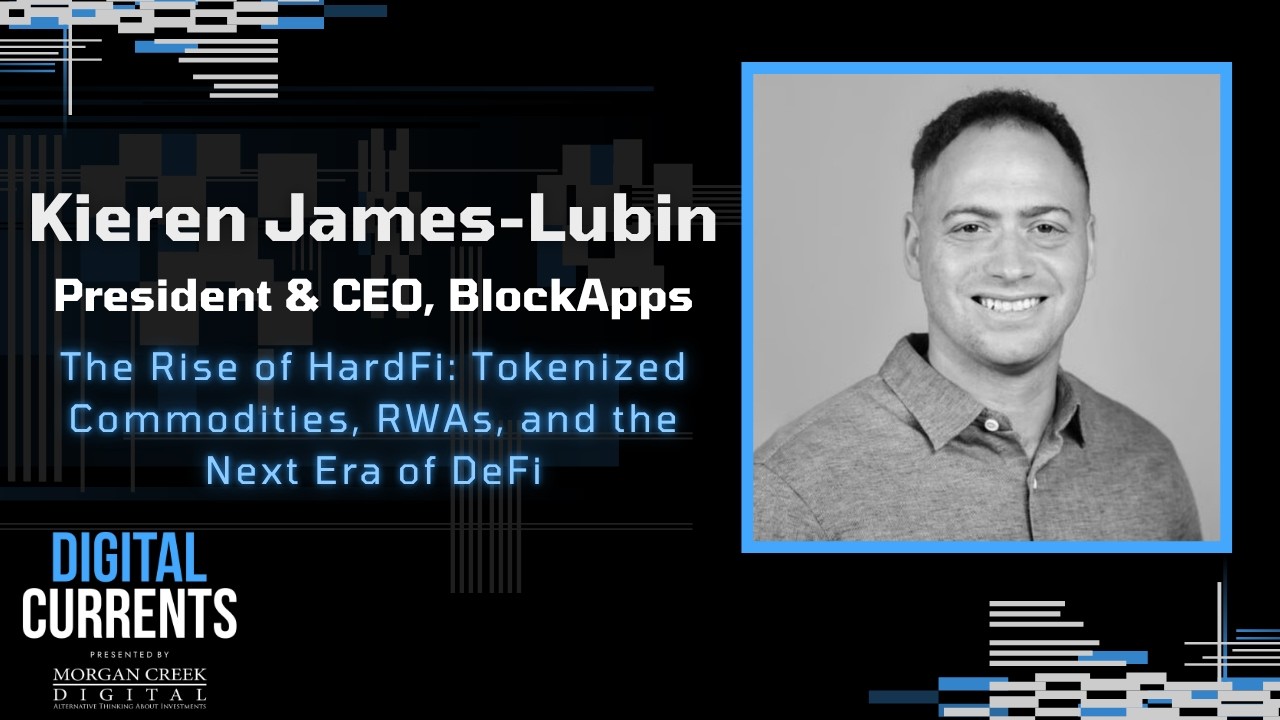
Video
This video is hosted on YouTube and cannot be embedded on external websites.
Audio
Transcript
Contents
- Introductions and BlockApps background
- From enterprise blockchain to tokenized assets
- Online vs onchain assets
- Vaulting, tokenization, and ETF comparisons
- Defining HardFi
- Collectibles, NFTs, and digital property rights
- Tokenized gold and collateralized liquidity
- Founder lessons and BlockApps history
- Health, AI, and inspiration
- STRATO token announcement and closing
Introductions and BlockApps background
[00:13] Xavier Segura: Welcome to Digital Currents, brought to you by Morgan Creek Digital. I'm Xavier Segura. Each episode we spotlight the topics and people changing the tech industry with a focus on AI, blockchain, chips and big data. Thanks for listening and please make sure to subscribe if you like what you hear. And remember, stay current. Mark, we're in folks today.
We have brought back one of our favorite founders, Kieren from now Blockapps Empowering STRATO, their amazing blockchain, which we'll go into in more depth. Mark, join me in welcoming Kieren.
[01:03] Mark Yusko: Kieren, thanks for being with us. And I like how we got the blue memo. So we're all in blue and I guess the only thing would be better if we were all wearing the Blockapps swag, but all good.
[01:17] Kieren James-Lubin: I may still have to mail more out. I think we've distributed some, but there's always more.
[01:22] Xavier Segura: Right? This is the part where I'll have to embarrass you a little bit. For the folks that didn't catch the first episode where we had you on, please go back and check that out. A lot of really good insights and just looking where the market is, but so a little bit of the TLDR.
So, Kieren, you've got a really unique background in crypto and your experience predates a lot of the modern blockchain industry, right? So before the institutionalization of crypto, before DeFi, before NFTs, you were there, right? And you were launching on mainnets and Ethereum before it was a thing.
And so now I think you are uniquely poised to do the new thing, right, which is figuring out how to bridge different worlds of TradFi and DeFi and kind of this topic known as HardFi. So we want to welcome you back and want to get to know a little bit more about some of these topics. And thank you so much for making time for us.
[02:14] Kieren James-Lubin: Of course. Thanks again for having me. The time flies, and I'm in the same room as when we did the last one a few years back and feels like yesterday. You guys look precisely the same, but you're too kind.
[02:30] Mark Yusko: It's my platinum year, Kieren. I made this up, right? So there's a thing when you're a kid, on the day of your birthday, when you turn that age, that's your golden birthday, right? So I'm like, hey, I'm turning 63. I was born in 63. This is my platinum birthday. I just had it last week. So I'm feeling platinum right now.
[02:52] Kieren James-Lubin: Happy birthday.
[02:53] Mark Yusko: Thank you.
[02:54] Xavier Segura: I couldn't have planned a better transition if we tried.
[02:58] Mark Yusko: Not scripted, just real like our assets.
[03:05] Xavier Segura: That's what we love about the show. Mark and I are not above using puns whenever possible. I think they can have a lot of meaning.
So on that idea of rarity and of value, maybe speak a little bit, Kieren, about since the last time you were on the show, some of the growth that you've seen out of Blockapps and how that kind of mirrored a reflection of the market, but then also knowing where we're going.
From enterprise blockchain to tokenized assets
[03:33] Kieren James-Lubin: Okay, I'll give a little bit of historical context. We can go into it in more detail as we go. So we have a long background of putting hard assets, real world assets generally on chain. Going back to really the first real world asset project on Ethereum with BHP Billiton. That was kind of 2016, 2017 era.
So already getting into the earth, minerals, etc. back then, before there was a name for NFTs and a bunch of people involved in that project went in their own directions, including us following in that particular market.
So as things have matured, we went through the enterprise phase. And the enterprise blockchain market really has kind of ended in one form and transformed in another. And what's become enduring about it is it was really about the assets the whole time. There was a big infrastructure focus. You could think about the early stages of the cloud where people would say, all right, well you can run it in my data center.
And a lot of that has been forgotten. What we're seeing now is that financialization is the demand. It started with pure native crypto assets. We wouldn't be here without Bitcoin, subsequently without Ethereum. But you realize that most of the world's value is off chain still.
Stablecoins have gotten huge, relatively speaking, well into the couple hundred billion in circulating market cap. And if you compare that against, let's say M2 or total outstanding treasury debt or something like that, it's getting into the like 1% kind of range, which is pretty substantial, real.
[05:24] Mark Yusko: From a standing start to 1%.
[05:26] Kieren James-Lubin: Yeah, pretty real. You look at gold, you look at silver, you look at tokenized stocks, it's more like a hundredth of a percent at this time. And so you have the technology being ready. We saw the stablecoin example. It's like, okay, the stablecoin is meaningfully better in some ways than a US Dollar, right?
If you are - Tether reports that something like 30% of their customers use USDT in a sense as like a core primary savings account. So if you're in a country that's inflation exposed or you just don't have good banking access, it's inexpensive, you can use it. A lot of people settle in it.
In the developing world - doesn't solve US dollar inflation, doesn't solve a more complex suite of financial products that are building up in DeFi and in TradFi.
And so clearly the next wave is all of those assets that are in the world today that you haven't been able to get access to on chain. So we made a big bet on gold and silver, really informed by the market, right? Following our enterprise days, we had sort of an NFT flavor RWA offering, kind of like an OpenSea for RWAs in which we brought everything to market.
Carbon offsets, tokenized whiskey barrels, collectible shoes, et cetera. But precious metals were actually the biggest volume, the biggest seller. And we kind of realized the demand for the asset on chain is roughly the same as the demand for the asset overall. Being on chain often brings some additional benefits like enhanced liquidity.
And so why do you tokenize? Sometimes you want to sell the asset, but quite often you want DeFi style leverage, purchasing power against the asset as well. And so we're seeing that with our depositor base, folks who have small amounts to really large amounts, relatively speaking, in precious metals, mostly they want to hold it, they don't want to sell. And the assets are relatively inert most of the time.
Gold is a very liquid asset if you're trying to go to a bullion bank and sell it for cash. Otherwise it's not so much, you got to move it. It's really a store of value asset, not a transacting asset anymore. Which is kind of strange given the very long human history of using gold, silver, sometimes copper.
Online vs onchain assets
[08:04] Mark Yusko: Let me pause you for a second and just back up one second because the words are important and you're living it. We are living it. Our clients are living it. But there's a whole bunch of people that aren't. And since I'm the old guy, I remember the days of offline, like literally where everything was physical, tangible, hard.
Like gold was a Krugerrand, a little coin that you put in your hand or a bar and bearer asset. And the quarters I used to get and spend were made of silver. And even the money, because I predate 71, was written on it that you could exchange this for gold or silver. You got a silver certificate.
And so all of a sudden that changed and took from 1971 to really 1991 when the Internet was created. And then we started to move from offline to online. But online kinda, right, in the sense that an image can be online, but that bar of gold still has to sit in a safety deposit box somewhere. So really what online was was a pointer to a document that was in a PDF form, or sitting in a cloud now.
And so now everything is online. Our lives are online, our images are online, our identity's online. But now we're moving into this on chain world.
And that's like the longest question ever. But describe the difference between online and on chain. Like what does it mean to be on chain? Because again, just the silly me, I use an example all the time. Let's say I had a bar of gold.
Like if I were Kyle Bass, like literally if he were sitting here with us, he could reach under his desk and he has a little safe and he keeps a 26 kilogram gold coin from Australia under his desk. It's a big ass coin, it's worth a lot of money. And say, well even if I had that coin, which I don't, but let's say I had a gold bar, I'm not strong enough to break it into three pieces.
Even if I were strong enough, I couldn't stuff it in the computer and send it to you. So there's something about online gold, it's not really gold, pixelated and sent through the air like Willy Wonka and Mike TV and on chain must be different than that too. That is the longest question ever in the history of questions.
[11:10] Kieren James-Lubin: Yeah, okay. It is a great question. To your point, even before blockchain crypto, the dollars were getting to be digital, right? They were first paper notes representing claim on some gold in some vault somewhere, which is hopefully all still there.
[11:30] Mark Yusko: Theoretically gold in a vault.
[11:31] Kieren James-Lubin: Theoretically there's gold in a vault somewhere, right. It progressed to more like a ledger entry, that some of our smart economists and bureaucrats basically type some command in and then the supply of money expands and contracts and central authority
[11:55] Mark Yusko: by fiat says you have money. It's like,
[12:01] Kieren James-Lubin: usually if you're - it's better for you to be as close to that event as possible for your financial prospects and so on. And so for some time dollars have been digital and fiat kind of lends itself well to a digital format. And on chain is different. Right. So of course with Bitcoin we made it so that in effect there is no party typing in, expand supply by this amount.
There are mechanical rules that control how the bitcoin gets issued, who it gets issued to and how it transfers and so on. And so no one fed or similar to try to influence, to put more or less supply into the world. It's done totally mechanically and that could have been the end.
Like, a lot of us have been around for some time in the space. We all hope that we would see remittances all happening through Bitcoin or through Ether. This was a big thing in the 2010s, early mid 2010s. People would say look, Western Union's taking 20% on dollars sent to the Philippines. Right. If you sent it with bitcoin, it's essentially fixed fee, much less than 1%.
Why don't we turn dollars into bitcoin on one side, send it to the other, convert back. And what ended up happening to somewhat the dismay of the really hardcore crypto folks, that use case is largely done with stablecoins today.
[13:39] Xavier Segura: Right?
[13:39] Mark Yusko: Right.
[13:40] Kieren James-Lubin: So the way stablecoins work, let's say in the Circle Tether format, which are the biggest ones - you put, in essence wire dollars to Circle. They hold them in some segregated account. They mint USDC, which is a token representing a claim on the equivalent amount of dollars and that circulates somewhat more freely than the dollars. It's always on. There's no wire cutoff window.
USDC is deployed on Ethereum and many other popular chains. And so the dollars just move. And in the secondary market there's no restrictions on how they move. I mean they can freeze in the case of law enforcement decree and so on. But really this is then expanded access to lots of different people.
So in the Internet version of money, you still had to onboard with the bank. The bank is a ledger of assets and liabilities not so dissimilar from there being a paper dollar and that being a claim on some fractions of ounces of gold, and so on.
It's a pure digital formula but still relying on the one counterparty where stablecoins are a move to - it's more like the Circles, the Tethers, et cetera are the trust anchor that helps keep the dollar. But beyond that it kind of moves much more freely. It doesn't need to find a route through various correspondent banks to get to a certain destination and so on.
And so on chain, in the purest form it means like Bitcoin - like the asset's born, lives, hopefully never dies, completely through self contained, self sovereign processes that the software powers and there's a consensus on who owns what happening continuously every few seconds or few minutes. But with tokenized assets you're getting a lot of that. But there's often a real world trust anchor on intake and on exit.
And the upshot is it allows you - there's just different forms of value in the world, right? Like the Bitcoin, it's less volatile than it used to be but it's quite volatile. Like if you wanted to live your whole financial life holding bitcoin, you better have a lot of it. You better have your expenses sort of tuned to the low end and it's still hard to convert.
You can't quite spend it at point of sale at least most of the time in fact.
But you can with stables typically right. So they're getting to be stable credit cards where in essence the funds get sent to a bank, the bank advances the real US dollar cash flag, they kind of settle up on the back end but to the merchant at your coffee shop they don't know that you paid with crypto. We actually do support this pattern through partnership with MetaMask.
So basically you can deliver stable coins to the card, the card fronts the cash flag, they settle up in the back end. And so you've got a crypto account. You don't actually need a bank account. It's linked to your identity and to your address on chain. And it at this point continues to expand access to a broader world that might not qualify for the bank account. Also you can borrow, right?
So one of the great things about DeFi is there's no questions asked credit. If you got the asset you can put it in a smart contract and draw stables down against it. So the asset could be ETH, could be a flavor of bitcoin,
[17:24] Mark Yusko: et cetera, really, proof of asset. And instead of proof of who you are and how you're judged by random credit scoring agencies. But the question I'm still struggling with, a little bit more philosophical than anything else, is an ounce of gold, platinum, silver. This building I'm sitting in, they can't actually be in the computer on the blockchain.
[17:58] Kieren James-Lubin: It's true, right?
[18:00] Mark Yusko: I mean, not yet. Maybe Willy Wonka and Mike TV will figure that out, but at least for now they can't. We can't transmogrify to take a Calvin and Hobbes reference them on truly on chain. So what is it that we have on chain?
Vaulting, tokenization, and ETF comparisons
[18:20] Kieren James-Lubin: So, okay, the ritual is important, right? So there's an intake process. Say you've got physical gold. We've got some number of insured partner vaults that do the intake. So you drop it off physically, you mail it, you arrange for a Brinks transport, and so on. They check it out, they assay it, they look at the proof of origin, etc. All checks out.
You put 100 ounces of gold in, you get 100 tokens back, right? So there's a continuous audit process that says, the number of ounces of gold in the vault is larger than or equals the number of ounces on chain.
So with a solid trust anchor, we're trying to be pragmatic, right? Like there's a flavor of bitcoin person or hardcore crypto asset only person that doesn't like this pattern. But what we're seeing just empirically is that stablecoins tokenized asset market cap on chain continues to go up independent of the adoption of the pure crypto assets, at least in terms of price level.
Like there is independent demand for this asset type. So with that minimal trust anchor, if you believe the gold is in the vault, then you're able to trade it dematerialized in a way that lets you trade with someone, anyone on the planet without going and mailing them gold, right? It's like it is much easier, cheaper, safer to leave the gold more or less where it is.
Hey, maybe you keep some for your mattress, but it is just much more liquid in a spendability and also credit form.
Once you've tokenized it, you could think of it as analogous to ETFs too. ETFs are on the order of 1 to 2% of the - GLD is pretty big, IAU. The ones like that, it's actually in a sense a stronger claim than the ETF. Like the ETF, they got management fees and all that, but you cannot typically redeem the shares for the gold. Or you tend not to be able to deposit physical gold either.
If you're a bullion bank, you can take the bars, drop them off and get shares and get liquid that way. But for an average person, you typically cannot get direct entry into them.
And so you see this a lot - there's a reason for this structure, but there's sort of like a little bit of a two tier system where the institutional players, they trade with each other at really low fees and there's a measure of gatekeeping that goes on to preserve the margin they get when dealing with externals, et cetera. So if you - again, I think tokenized assets are in some ways just strictly better than ETFs.
Similar liquidity benefits. Sometimes more direct borrowing tends to be cheaper within DeFi than say like a brokerage margin loan. It's 24/7, et cetera.
Defining HardFi
[21:32] Xavier Segura: Now Kieren, you mentioned a pretty interesting thing about just that evolution of Blockapps and STRATO. Kind of going more on the B2B enterprise side and coming more onto the consumer. And I can't help but think about how that pattern is kind of mirroring what we're seeing in financial markets today.
So maybe defining some terms before we talk about a topic that we had a nice conversation in the green room. We always say we wish we could record what happens prior to the podcast because it's always unfiltered in the room.
[22:03] Mark Yusko: Where it happens room.
[22:05] Xavier Segura: Exactly where it happened. But maybe this idea of if you can define for us what you consider is HardFi, right? This idea where we're kind of melding different worlds and then maybe how that can transition us into thinking about why hard assets matter.
[22:21] Kieren James-Lubin: Yeah. Yeah. So I think HardFi, we mean taking hard assets and applying DeFi and I guess some TradFi principles to them to make them more productive. So gold and silver in particular, we haven't done platinum to date. We certainly could. We were talking about it earlier. Platinum is great in that it's I think even less physical volume taken up than gold per dollar. Right.
So there's less circulating in the world. But it's really one of the good things about spot gold and silver is you don't need that much space to store it whereas like copper, it's like a whole logistics operation. Yeah, probably don't.
[22:59] Xavier Segura: Can we make one request, Kieren? If you do the platinum, can we have like a rune style encryption for like the Mark Yusko platinum?
[23:07] Kieren James-Lubin: Yes. Get some special.
[23:09] Mark Yusko: 5-9-1963.
[23:10] Kieren James-Lubin: Yeah, all right, we're on it. We're on it. But yeah, so I think these assets have been underserved. And so to your point on dealing with the consumer, it's not as if we're like Robinhood per se that's trying to really get everyone maybe within a certain age range, etc. It's still a specialty product.
But you can see big overlap between kind of like the gold bug personality and the crypto personality. Those who were early on crypto and maybe often held a bunch of gold often are doing pretty well these days. So I would say kind of the aim ends up being more mass affluence to even a certain kind of high net worth. Like who's got a few million bucks of gold sitting around?
More people than you would think, but not like -
[24:05] Mark Yusko: No, it's actually amazing. It's an amazing stat in that our image is that the wealthy, particularly multigenerational wealthy, do have these big stacks of gold somewhere, in the vault or in the Swiss bank account. But in terms of ownership of gold, I think it's - I'm pretty sure I saw this number from Morgan Stanley or JP Morgan.
It's sub 2% like - the vast majority of people have zero exposure and certainly it skews to the wealthy. I mean the average person who - it's crazy to me. 49% of people in the US don't have stock. Right. They don't have a 401k, they don't have 403b. They don't have Schwab account or even a Robinhood account. They just don't own stock. So they certainly aren't going to own gold.
But even then it's much less widely owned than the banter on Twitter would have you believe. And interestingly, I think now the ownership of Bitcoin is higher. And it's funny, I'm with you. I don't know that you have to be either or as much as - I think bitcoin is digital gold. And I think it has all the elements of gold in terms of scarcity and durability and a store of value, and can be a medium of exchange.
And it's an asset that exists in the absence of a liability, which is the definition of money. It's more divisible and more portable. Like I said, if I had a block of gold, I can't stuff it in the computer with a couple of taps of my finger, I can send you both bitcoin. So that is different.
But that said, there are things that could happen either. And I never leave it on my phone, so don't try to sim swap me, but I don't leave it on my phone. But if something happened to the bitcoin network or to the Internet at large, I mean, things could happen. Whereas we've all heard the stories of the woman with her earrings that got through the war by bribing the customs official.
And physical, tangible value has a role, probably a small role, but it has a role. The next layer of permanent, durable money, I think should have an increasing role. And that's bitcoin.
But then there's all this other stuff, which is, what about art and what about collectibles? I mean, God love all these kids whose moms are now tearing apart the house trying to find their Pokemon cards. Because the best performing asset in the last 10 years is not bitcoin, y'all, it is Pokemon cards. And it is crazy. It used to be collectible Porsches, right, because of the dentist wrap phenomenon.
Dentist buys Porsche, wraps it around a tree, end of car. The ones that don't get bought by dentists live on, and there aren't very many. And Jerry Seinfeld will pay you whatever it takes to get rare Porsche. And so that was number one. But now Pokemon cards have exhausted that, because those cardboard cards that you open the pack, it's cool, you get the hit.
And then they go in a drawer and some people put them in the sleeves and they look at them occasionally.
But, I mean, God, as a stamp collector growing up because Pokemon cards didn't exist, I have in my house somewhere, I don't even know where it is, a giant collection of postage stamps. I probably do have some stamps that are worth a meaningful amount of fiat if I could find them and find a place to sell them.
But there was a kid yesterday who found - his mom found his entire set of 1999 mint because he put them in sleeves, Pokemon cards. He's like missing two. That's a pretty valuable asset. So how do we put that on chain or things like that on chain?
Collectibles, NFTs, and digital property rights
[28:11] Kieren James-Lubin: So I want to say, just to comment on those sort of things, we're in the AI era now, so it feels like pure digital anything is - there'll be a few.
[28:23] Mark Yusko: Okay.
[28:24] Kieren James-Lubin: In number, there'll be more awesome pure digital assets, but there's just the ability to generate anything is so fast and cheap right now. There's going to be a flood and then you're going to look and see, okay, what's actually scarce to your point. Pokemon cards are huge. I don't know them personally, but like, the folks at Courtyard are doing great with tokenized cards.
[28:48] Mark Yusko: The -
[28:48] Kieren James-Lubin: The mechanism ends up being kind of the same. Right. Like you need some - so the cards are unique, right. They'll be more NFT-ish than gold is fungible. Obviously you make it more fungible with the token.
[29:02] Mark Yusko: That's a really important point. Draw that a little bit because people hear that term fungible and they don't really understand it. They're like, oh, yeah, I know what that means. But that's a really important point.
[29:13] Kieren James-Lubin: So, yeah, so fungible sort of means that there's just - like gold A is pretty much equivalent to gold B. Right.
[29:22] Mark Yusko: An ounce coin is basically an ounce coin. Now, one may have a koala on it and one may have an American eagle on it, but it's still an ounce of gold.
[29:32] Kieren James-Lubin: And yeah, in the worst case, right, you melt it down and it's really the same.
[29:36] Mark Yusko: And really the same.
[29:38] Kieren James-Lubin: There's this final form of it. The institutions like LBMA good delivery bars, which are 400 ounces, I believe. So I mix up my troy ounces, my ounces sometimes might be 430 troy, 400 regular, or maybe the other way. But basically, yes. So gold is pure. It's inert, so you can get it down to this common form. Dollars are basically fungible.
I mean, actually, often both of these things have serial numbers on them, but you don't really look at that. It's just one is basically equivalent to the other.
[30:14] Mark Yusko: Yep.
[30:15] Kieren James-Lubin: Pokemon cards. There's lots of different types. So you might have, I'm forgetting the term have -
[30:22] Mark Yusko: Charizard versus Charizard.
[30:24] Kieren James-Lubin: Yeah. And so that is part of it. It's also this quality.
[30:30] Mark Yusko: Right.
[30:30] Kieren James-Lubin: So part of what you're establishing with the vault on the gold side, but also - so you really don't want to move these things around too much if you want a liquid market because storage conditions - they can even too much light exposure can degrade them. Or you really want it in that plastic sleeve that keeps the oxygen out.
And that's the best way to - so yeah, the people with the binders are preserving the value by like never taking them out of there, basically. And so there are groups to do gradings. I think on a 10 scale where mint condition's 10, you get pretty good. You've got a first edition Michael or, sorry, like a rookie Michael Jordan. If you get an eight, maybe it's worth $10,000. You get a nine, it's like a hundred.
If it's a mint, it could be a couple - it's almost like an exponential effect for the quality. Yes, right. The quality drives the rarity. And so that actually makes gold a better monetary asset, obviously. Right. But from a value perspective, if you're the type of person who saves things and you do it really well, this means you can kind of outperform with -
[31:40] Mark Yusko: And I think it's important it's non fungible. Like NFT got a bad rap, right. Everyone said, oh, monkey JPEGs. No, no, no. Non fungible token. Okay, let's break that down. Okay. Non anti fungible, equally substitutable fungible. So non fungible means one of a kind. Like that picture back there actually is a one of a kind. Now it's not super valuable, but there's only one in the world.
My friend made it for me and it's got my name in it. And so, I mean, it's kind of cool, but it's a one of one. And so non fungible just means unique token, which everyone's like, oh, that's a little gold coin. I'm like, there's no gold and there's no coins. A token is a line item on a ledger. And ledgers are really important and they're the basis for pretty much all of humanity making sure that ownership matters.
But to me, NFT missed it because it should have been called digital property rights.
[32:42] Kieren James-Lubin: Absolutely. And that's how I explain it to people. I say, vehicle title, the deed of your house. Really, it's a unique thing. There's an address. There's a license plate number, a VIN. It is this one, it's not that other one. It's this one. There is only one and you can transfer it. And to your point, a lot of what governments do is just sort of record those transfers and take -
[33:12] Mark Yusko: And take a cut.
[33:13] Kieren James-Lubin: Take a cut. Permanently.
[33:14] Mark Yusko: Permanently. Like when we say we own property, this is the weird one, right? I never really thought about it until crypto Twitter started really railing on it. It's like, well, do you really own it if you have to pay a tax on it even after you've paid off the mortgage and if you don't pay it, they take it from you by force? That doesn't sound like ownership to me.
[33:38] Kieren James-Lubin: The metal landlords at the end of the - you own a - but they own everything. On some level even I think like Virginia has an annual vehicle tax too. Those usually don't have ongoing per se.
[33:55] Xavier Segura: So returning I guess to gold and that was kind of one of the core thesis about immutability and ultimately a store of value. One of the reasons we invested in Blockapps and we continue to be supportive in STRATO is because we believe in HardFi as a category with enormous potential. Right. So if you look at gold we're talking about that's a market cap of 30 trillion or so in 2025.
[34:16] Kieren James-Lubin: Right.
[34:16] Xavier Segura: And if you look at the tokenized gold market, as you mentioned Kieren, it's a fractions of a percentage, right. At roughly 5.9 billion. But it is rapidly growing. And we're not saying that STRATO is the only place to buy tokenized gold. But there are some advantages that I think have been really interesting.
The idea that you can have gold, you can be a gold holder but still have access to liquidity without selling. You can manage this. Diversified collateral positions rotate between crypto and commodities. And this could potentially generate yield from ultimately a non yield generating asset. Except for this year where it kind of went through the moon.
But maybe speak a little bit about the advantages that you guys are positioned relative to the incumbents.
Tokenized gold and collateralized liquidity
[35:02] Mark Yusko: Yeah.
[35:03] Kieren James-Lubin: So let's talk about it for a second. Why you would want to hold your gold is, Mark's kind of making the case. Like those Pokemon cards, you just hold them as long as you can and they like, why do they keep going up? And I think often the answer is like we are sure to print more dollars. We've got a lot of debt. We've got to refinance the debt.
I think the world will continue to mostly transact, especially internationally in dollars for some time. But you're actually seeing a big rotation in central bank reserves where gold is larger now than dollars or - yes.
[35:38] Mark Yusko: For the first time. For the first time ever. Yeah.
[35:40] Kieren James-Lubin: Yeah. And so everyone is realizing that to some degree we're going to have to break the dollar compact. We got just liabilities beyond what we can pay in a strong hard dollar. And so we're going to have to make more of them. Which means you repay, but you repay in a way that you have less purchasing power than when you lent the U.S. government the money. Perhaps. So what do you do?
Like if you're like people, were seeing expensive gas, right. And part that's due to the war, but it was probably going to tick up some anyway. We saw really big inflation after just the gigantic money printing events in COVID and we're kind of just, we just seem like we're going to stay on this path which means that everything is going to get more expensive and it's going to get more expensive uneven.
So immediately when we printed a ton of money in COVID like PE ratios in stock market went from like 20 to 40. I don't remember exact numbers. And the reason is like the people who get the money first in a sense are like the big institutions and the folks with assets. And so the bid first goes into liquid high quality sort of scarce stuff. Google's not issuing more stock. You got to acquire it on secondary.
It's a great asset. So that just goes up immediately. So if you're a person, Mark to your point, half the country that doesn't have stocks, you don't participate in this upside and they call it the K shaped economy. The slow trend is that you can't make it on income alone.
You better hold assets because they're all getting more expensive and maybe getting more expensive faster than you can like get the down payment for the home together or -
So what we let you do is hold the thing you like, right. Gold. We've seen this huge run up and one of the things - so bitcoin as digital gold. True. However, it's still kind of a risk on asset. Right. Like markets go up, markets go down, Bitcoin goes down. Gold is still meaningfully countercyclical. In kind of the way bonds are, right, like the world looks shaky, gold goes up, silver goes up, oil goes up, et cetera.
So if you think about just like a regular person's edge, they probably want a little bit of each asset class.
Now by making gold easy to acquire in small units, it's not like - so a whole ounce is, I don't know, I didn't check today. $2,700. Right. You don't need to go acquire a whole ounce of gold. We can do basically any quantity. That's the nice thing about tokenization. You can fractionalize and that makes it just easier to get into the asset.
You've seen folks like Robinhood fractionalizing stocks and that definitely drove retail adoption. You can get in easily at a small ticket, put a little bit away every month. Then you don't want to sell the thing if you can't. Right. People borrow money on the credit card sometimes, like in these inflationary times, sometimes to pay bills. This is not a good thing. 24%, 36%.
If you could instead hold on to as much of your assets as you can and conservatively get some credit against them, that DeFi borrowing. It's like 4%.
And so thinking about it as collateralized against assets instead of your income like a credit card, you suddenly have a much better deal due to the stronger financial position you're in and are more able to just get on that asset owner ladder. That is just a requirement these days. Like again, probably not going to stop printing the dollars, that'll -
[39:39] Mark Yusko: No, look, it's pretty axiomatic in the sense that debt either has to be one of four things, either has to be paid back. Okay. And the problem for all the western nations, not just the United States, but Japan and Europe is even if you seized everybody's wealth, forget their income, their wealth, you couldn't pay it back. There's just not enough. Okay. So that's off the table.
So then you can restructure it, say, all right, Kieren, you got Treasury. I know you paid 1000, but I'll give you 500. You got to have a willing person to take the haircut. And most people are going to say, hell to the no. It's supposed to be a government bond. I want my money. So restructuring is hard. It's not impossible, but hard.
Third is, you can default on it. Nope, nope. Only third world countries with dictators default because they've already stolen all the money before they default. So in lieu of that, people like politics. It turns out politicians like staying in power. I know that's shocking to everybody on this call, but it's funny how that works. So they don't default. Western nations just don't default.
So then your only thing left is to devalue. Because if I borrowed a dollar and had to give you back a dollar, but I could print another dollar out of thin air by fiat, now I'm paying you back with something worth 50 cents. It works for me. So I get rid of my debt for half the cost.
And it's really interesting that this has happened over and over and over throughout the history of civilization. And we just forget, right, we forget that the UK did this in 1843 or whatever it was 46. I don't remember the exact date. We forget, right, that we kind of did this Post World War II with Bretton Woods.
I mean, we had massive debt and we kind of worked out a deal where we erased some of Europe's and we - so you just erase it. And what that means is things cost more and to the point of income and wealth inequality. The people at the top. I don't care if a Coca Cola cost $4 or a dollar.
[42:15] Kieren James-Lubin: I really don't.
[42:16] Mark Yusko: I'm just going to pay for it. But, man, $4 for things. And again, I'm just old. But a dime. I mean, literally, me and Roy Williams were sipping cokes for 10 cents. And it was the bottle, it was only 7 ounces. It wasn't the full 12 ounces. So call it a quarter, but a lot less than $4. And so - and there's - it's graduation time.
And if you haven't watched it, watch Eric Church's address to UNC the other day. It's maybe the best graduation speech I've actually ever heard. I was shocked. I mean, this guy is amazing.
But more importantly, there's a speech years ago, arguably it was Kurt Vonnegut. Turned out it wasn't. It was a Chicago Sun Times writer. It was called Wear Sunscreen. And it basically said, my advice is one, wear sunscreen and then a bunch of other things. And one thing he says is as you grow older, you'll recall that prices were reasonable when you were young. Like, oh, my God, exactly.
And yet here we are at much higher prices. I mean, my first house right. We struggled to buy because we had a little windfall inheritance from when my great uncle passed. $10,000. And that was enough to buy a house that doesn't even push a down payment on a car now. Right. I mean, it's crazy.
[43:53] Xavier Segura: Yeah. And I think maybe we've reached the point of the show where we can maybe go back in time, Kieren, because I remember when we had you on the last episode of Digital Currents and we did the lightning round, there were some interesting hot takes about kind of how the best blockchains or crypto are invisible.
And this product is very much a visible one because we can kind of interact in a special way. So we kind of get to that fun part where we maybe get to see if some things have evolved since the last time. Not changed, but evolved. We can always change our mind when we have better data and information. So we'll turn it over to the fun part of the episode. The famous Mark Yusko lightning.
Founder lessons and BlockApps history
[44:35] Mark Yusko: Well, I don't want to ask the same question. So we're going to do lightning. I won't get my notes. We'll just do some things I would love to know about Kieren and about the company. So Kieren, you're a founder and a CEO. And what makes great founders? Like, and I know you're humble guys. You're gonna say, I don't know.
But tell me, what do you think makes somebody able to be a founder and someone who likes to build things?
[45:11] Kieren James-Lubin: Yeah, I think, okay, a couple baseline things gotta be like pretty smart. You probably don't wanna be - there's almost an upper limit where if you're like, you really should be working in a top tier math department or physics department or something, you might overthink things a little bit, but you got to be.
[45:33] Mark Yusko: That's a great point. That's a really great point. Overthinking. Yeah.
[45:36] Kieren James-Lubin: I think you got to be smart enough to see around a corner to see, to be a little bit contrarian. But not get into the too much analysis paralysis and -
[45:51] Mark Yusko: Okay, keep going.
[45:52] Kieren James-Lubin: I was gonna say. Yeah, the comfort with like just not knowing what to do and doing stuff has been a continual theme. Like, we've done many things under one roof, conceptually linked, one did lead to the other, etc. And we're at the best point yet in the history of the company. And it's feeling the real product market fit in the pull.
Like, you kind of know when like the customers want the thing almost more than you can deliver it. That's the - we've finally achieved at this point.
But it's like people, most of the population is not comfortable just doing stuff. Like they'll sit, they'll think, they'll either not do stuff, they're waiting for direction, they're waiting for a perfect angle, or they're just not interested in any kind of area that's unexplored. Like the frontier spirit. You're going to go out there, you don't know what's there, but it's going to be okay.
Is maybe the important thing. And to just kind of like be honest with what you're seeing, like crypto market has morphed four times in the course of the one company, right?
And you can't just chase the narrative, but you gotta react to - reality has the answer, right? Like often a company is an answer to some lingering inefficiency or something that we haven't as humans dealt with yet. New opportunity that's there. But you got to really be honest about what it is that - because it's easy to lie to yourself. It's also easy to lie to yourself in like, friendly capital markets, right?
Like, everyone suddenly believes that they're an AI founder. And PowerPoint to AI is awesome, using all day, every day. But it's - you need that period where you don't know if the thing is going to work and everyone thinks you're crazy and then you want later people not to think you're crazy. So you want to be like two years ahead, maybe not 10 years ahead of the -
[48:01] Mark Yusko: Oh my gosh. I mean, there are so many nuggets in that answer that we could literally do an entire show just on the components of that answer. I mean, the one on the superpower, right, which is to act with imperfect information. The vast majority of us want perfect information.
And in the information age, that's impossible because you're inundated with information and every time you think you've got all, something else comes up. And so that ability to just act and do things, I think is an incredible superpower.
I loved your point about, look, you gotta be honest and if it doesn't work, you gotta pivot and if it's working well, you gotta do more of it. And there's that great line, right? We should do more of what's working and less of what's not. Kind of a funky thing, but unfortunately, again, human beings are prone to do the opposite.
We want to prove we're right, so we try to do more of what's not working to show that no, no, we're right and the market's wrong or the customer. Customer's never wrong. So again, just incredible number of nuggets. So what's been the most fun you've had in building Blockapps?
[49:20] Kieren James-Lubin: Oh, man. Different.
[49:23] Mark Yusko: Okay.
[49:24] Kieren James-Lubin: There's different eras of this. Wow.
[49:27] Mark Yusko: Okay, I like that. Different eras of fun.
[49:30] Kieren James-Lubin: Ethereum mainnet launch. People went crazy. This is like we were like my co-founder was controlling a fleet of like 30 Amazon GPU spot instances. And for like a day was like 20% of the mining power of the network. There was just like this spectacular excitement about this yet to be technology that I've barely seen since.
Like, for instance, for the ChatGPT revolution that we all witnessed, I would call that like much more mature than Ethereum was at that time. That still got this like, oh my God, this is the beginning of the new Internet moment.
[50:13] Mark Yusko: Yeah, Again, that's such an incredible insight because AI is 70 years old.
[50:19] Kieren James-Lubin: It is, yes. I mean, five years. Right.
[50:25] Mark Yusko: We've had chatbots since 1957. We've had chatbots since 1957. Now they have gotten better. I'm not saying that ChatGPT is as good as that, or is less good than that very first chatbot. But we had it in 57, then we had an update in 87, and now here we are in 2024, whenever it was released. 23. But I think that's important.
And so Ethereum and blockchains beyond Bitcoin, because Bitcoin is a unique animal. Ethereum also differentiated and unique. And to your point, I mean, very new technology. I mean, that's cool. So on the other side, flip side of fun, what's been the hardest thing you've had to do since you started?
[51:20] Kieren James-Lubin: Good question. I think like the - so we've had a couple different models that got into like a pretty good success level. Like, a few million a year. Kind of like getting like gigantic corporations. Like we had like 10 oil and gas companies transacting in a consortium or a big part of like a critical US agricultural supply chain, et cetera and all of that stuff.
You could tell like if the corporates and all that were really committed, the thing could have been huge, 10 years before. It all will eventually happen the way that we expected it, but it just didn't - a lot of that stuff. Also, the pandemic really made wave one enterprise blockchain kind of not work. Right. It was probably too early anyway, but it really, it was actually very collaboration heavy stuff.
Like you had to meet with the industry and design data models together and so on, and then you couldn't travel, right?
So had to pivot through that. Kind of like had some contracts were like, hey guys, like, maybe we just shouldn't renew this year because like, we know that you've invested a lot of time and money.
We've invested a lot of time, but we kind of know that like you're transitioning, Fortune 50 company, you're trying to get Zoom stood up so that - or a little bit later, just the prices all went up on commodities and suddenly, this was the thing they had to deal with.
So like also, so I wasn't like, kind of like a philosophically fully like a mainnet crypto guy, but I've been early days. It was like the people were so crazy that it kind of like repels you're like, should we go like - there's, I like the religious element of decentralization.
[53:40] Mark Yusko: Yeah.
[53:42] Kieren James-Lubin: It could be taken a little too far. We've got Bitcoin Maxis. That's a religion. We've got the Ethereum religion. We kind of got the Solana religion. Now everyone who's holding the bag is religious in a certain way, but it's not even about the money. It's like there's a philosophical purity in the early days, which was both awesome, but I sometimes found off putting.
I was like, we got to get normal people to use this stuff.
[54:08] Mark Yusko: Yes, yes.
[54:10] Kieren James-Lubin: I like, we thought we were late in like 2015, but bitcoin had been there for a while. Ethereum is the new thing. We're like, yeah, this thing, the whole landscape is mature and of course it's like probably still early, really -
[54:28] Mark Yusko: Really important piece of advice. I talk about this all the time. Tim May, God rest his soul, he wrote the Crypto Anarchist Manifesto. He was original cypherpunk. And he wrote this thing 30 years before this all happened. Like predicted every single thing that was going to happen. It was, I mean it's crazy and it's only a few pages, but he wrote this thing and for 20 years from 1989.
No, I'm sorry, for 30 years from 1989 when he wrote it till 2009. Didn't matter because he was a libertarian hermit that lived in the woods by himself, didn't interact with people. So you can have this great idea, but the segmenting yourself off to, oh, I only talk to libertarians and I only talk to cypherpunks. Like, okay, you're not going to change the world.
Now his work did change the world and contributed along with others to what we all do now.
But I love your point about look extreme, you're going to be off putting to people and they're not going to want to follow you. And in the worst case of extreme, it's where the term drink the Kool-Aid comes from. It ends badly. So I love that. All right, being cognizant of time. What do you do for fun?
Health, AI, and inspiration
[55:47] Kieren James-Lubin: I'm a master sprinter. I did indoor nationals last year. I didn't this year. I've been so busy, but I came in like seventh in the 60 meter in a small field.
[55:59] Mark Yusko: No, look, it's awesome.
[56:01] Kieren James-Lubin: Fast in absolute terms, but it's like a good adult hobby because the times are getting faster still fairly. You're getting healthier. You're defying -
[56:11] Mark Yusko: I'm gonna call you because I read this, that it was good and there's this young guy, Tyrone, he's a crypto founder and he was a like world class sprinter. And I can do that. And I went out and I started too fast and like, oh yeah, muscle, the muscle calf. And I was hobbling for a week. I like, okay, I like the idea of this but I need instruction.
So now I was going to ask you, I believe as many health is wealth because without it nothing else matters. So we know now what you do for health. You run and stay healthy. Okay.
And that was the other thing I was going to say is as a CEO, the perception and truth is pulled in every different direction. And again, back to this Eric Church talk. He talks about the six strings of guitar as the six foci of your life, the pillars of your life. And the world pulls them out of tune. Sound like, oh, that's such a perfect analogy. And if you play it, oh, it just sounds bad and you got to stop.
And he's like, gotta have the humility to say, okay, it's out of tune and I gotta take time to tune it back up. So where, to that point, where do you go when you need to recharge the batteries?
[57:34] Kieren James-Lubin: Man, I wish I had a better answer to this. I guess I do it with distraction, like a little bit like intense activity, doing the sprints, sometimes like to take a long drive, go with the - I went to the Keys with the girlfriend recently, for instance. Fort of Keys. Something where like, you can't be thinking about work.
But even then I - again, the AI was supposed to have us work less, and I think all of us just work more. I'm like, I work both weekend days, maybe like a half day, sometimes more. I didn't know I could pre-AI. I was still working all the time. But you can get a little bit more done. Just kind of keep prompting it and it gets you going.
[58:22] Mark Yusko: That's the problem with AI for me. Yeah, the problem with AI for me is it's the ultimate rabbit hole.
[58:31] Kieren James-Lubin: You can just keep going, you can -
[58:33] Mark Yusko: Keep digging and you can keep learning. And if you are a lifelong learner, if you like learning stuff, there's no end to what you can learn with these tools. Because while I don't think they're intelligent, I think it's a misnomer. And I think they are tools, not this other thing that people believe, but they can process more stuff than any human and they can reach corners of the world.
Now we still can't get to the Alexandria scrolls because they supposedly got burned up. Maybe, maybe not. Maybe we can explore that.
But the ability to learn about things, like just silly example. So we have a portfolio company that we're investing in now, and they have an agentic system that helps companies go from their old code base to new code base. Really good business. And I said, huh, could you use that tool to design semiconductors? Thinking maybe it's a stupid question. And the guy came back at me like, that's interesting. Yeah, yeah.
In fact, over the weekend, right, I reverse engineered this open source design tool and I think we could. And now I got to read it's 425 pages. And so now I'm going to read the 425 pages because not that I have to, but because I'm really interested in this. And so I agree they lead you down paths that are wonderful and incredible. But take away from other time. All right. But the six strings are important.
So you do have to balance the faith and the family and the career and -
[1:00:21] Kieren James-Lubin: Yeah. I don't know the solution in the short run, I've been. It's been like a good four to six months of unbalance and -
[1:00:31] Mark Yusko: Go to an island in Italy or Greece or Spain and just be gone for a week and that'll help. All right, last one. Where do you look other than the AI tools for inspiration?
[1:00:48] Kieren James-Lubin: I think I try to talk to people and ask just like simple questions about how they achieve things like in their life. Like, you'll find -
[1:01:03] Mark Yusko: Okay.
[1:01:04] Kieren James-Lubin: One thing that we found surprising in just our kind of HardFi DeFi run up is like a very big chunk of crypto people don't use DeFi. Like, hey, you ever used Aave? No. Like you've been holding ETH for how long? 10 years. Like, okay, what do you do when you - He's like, well, you either don't spend it. Maybe you stake it on Coinbase.
[1:01:26] Xavier Segura: Yeah.
[1:01:26] Kieren James-Lubin: Or you sell it. It's like, what, like what the - the hard edges of like, the future's here. It's not evenly distributed. Right. So if you just - you get a lot out of just observing people in their default behavior.
[1:01:43] Mark Yusko: It -
[1:01:43] Kieren James-Lubin: It takes so much for people to change, even to something clearly better.
[1:01:49] Mark Yusko: Oh yeah, 100%. And again, talking to people and listening to them and thinking, wow, they may know something I don't or they may have insights. And I love your point about observing their behaviors because we're all - I talk about - I am the cobbler's kids have no shoes. Don't ask me about my 401k. In fact, I keep it crappy now just because it's so bad.
So I had this one rollover IRA from my first job a hundred years ago. And it's so badly managed because I just never get to it. And that's just - I'm not proud of it. It's insane. And I should have just given it to somebody to do or - but you're right. The future is here, but it's unevenly distributed. So I lied. There is one last question. So since you said you like to talk to people.
If - and I think I did ask you this before, but if you could have dinner with anyone alive or in the past,
[1:02:50] Kieren James-Lubin: who would it be? Like, yeah, like, Newton's a good answer. He's probably a weird guy, right? Like, from all the - but he had both the physics and, like, the monetary stuff would be interesting.
[1:03:06] Mark Yusko: He would be incredible. Say, what the hell were you thinking?
[1:03:10] Kieren James-Lubin: Like, literally.
[1:03:12] Mark Yusko: And that's so perfect for right now because we're watching super, super smart people look at charts that only - look, this is the thing. When a chart does this, there is only one other side. It never goes like this. It never goes like this. It is the Eiffel Tower. I mean, there are no exceptions now. You don't know when.
And the South Sea bubble was - and he was one of the smartest guys ever and almost wrecked him completely. And the worst part of it is he got out.
[1:03:51] Kieren James-Lubin: Then got back in.
[1:03:52] Mark Yusko: Yeah, back in, because it kept going. And so funny. So when I was speaking early on in this whole thing, I was down in the Cayman Islands and I was talking about digital assets, and someone said, well, I don't want to buy crypto or Bitcoin or Ethereum, so how could I play it in the public markets? I'm like, well, you really can't.
Except there are these two companies where people are using the video cards. Like, I'm a gamer because my kids. And so they're using the video cards to mine Ethereum and some other crypto. So maybe you could buy AMD or NVIDIA. And -
[1:04:39] Kieren James-Lubin: Yeah, so -
[1:04:41] Mark Yusko: So now - but here's the crazy part. So - and someone said, well, why didn't you do that? And I'm like, well, I did. I picked one and I picked the cheaper one because I'm cheap. I'm a value guy. So I bought a little AMD at 2 a few years ago. It hit 30. And I'm like, oh, my God, I'm so smart. Awesome.
[1:05:04] Kieren James-Lubin: Out.
[1:05:05] Mark Yusko: So my son, so he got a little money when he graduated from eighth grade, and we said, all right, what do you want to do? Buy some Apple, buy some NVIDIA, buy some AMD. No, they're so expensive. Don't do that. And he's made almost as much as I made - not quite, but almost as much as I made in a year. I mean, that's not true. He made four times his money on AMD in a year. So good dad.
Yesterday, he's like, tweeted, I text him, like, maybe you should take some profits. Charts don't go like this forever.
[1:05:53] Kieren James-Lubin: And -
[1:05:54] Mark Yusko: And you crushed it. I mean, you crushed it. And anyway, we'll see what he does. But one funny story on that. So I don't know if I ever told this on podcast before, but so we had two older kids, 37, 35. Then the caboose came along. My wife stayed home with the first two. She was working when he came along.
So he's had a babysitter and his babysitter has spoken Español de él since he was five weeks old. So he is bilingual. I am not. So to help him do his homework, I'll use Google Translate and I'll say, okay, for dinner, we had mashed potatoes and gravy. How do you say that?
And so six years ago, when he was nine, I said, all right, when I grow up, I want to be a fireman. He says, no, dad, when I grow up and have your job, I'm going to be the head of Morgan Creek. I'm like, okay, smart guy. What we try to do is we try to buy stuff today people are going to want tomorrow. So what would you buy? And without skipping a beat, he says, computers with holograms. I'm like, I am out. I am done.
You're in charge. Where did that come from? He says, one of my TV shows. Like, you can watch that TV show all the time. And it was amazing.
Anyway, so fun stuff. And you talked about it, right? Two years early good. Ten years early bad. Because that's the euphemism. Early is the euphemism for wrong. But again, being able to stomach being called crazy.
[1:07:20] Kieren James-Lubin: Although -
[1:07:21] Mark Yusko: And you know this, especially growing up in the family you did, you can judge the quality of an idea by the vehemence of the detractors, but also the quality. So when people like Warren Buffett and Jamie Dimon say you have a stupid idea, maybe there's something there. Just a thought.
[1:07:46] Xavier Segura: Right, right. And of course, I think, Kieren, you may have been the first to say Newton as the person to meet, but that's perfectly in keeping with bringing all the way back to your original background in math and physics. So a perfectly on brand answer there. Maybe we wouldn't let you go without maybe any big news or update that you want to share with the audience listening.
STRATO token announcement and closing
[1:08:11] Kieren James-Lubin: Oh, yes, absolutely. So in the spirit of being early. So we, again, we've been running as a sort of a sovereign L1 chain for a couple of years now. And there are a bunch of aspects to that. For instance, you need a mechanism to meter the thing. So we actually have a native stablecoin. That's what you kind of pay the gas in for those in the know.
But it isn't really all the way there until you get your equivalent of Bitcoin, of Ether, et cetera. What's the real native commodity at the center of the system that's not dollar pegged and so on.
And so we will be doing this very soon. So think of it. It's called STRATO. The token will be called STRATO. Think of it as like Ether but also a little bit like HyperLiquid for fans out there where it's got some of the DeFi features to it. So you stake it when we have in-system borrowing, it will be a little bit less expensive if you hold some of it. You need to hold a minimum to run a validator and so on.
And so it will be the mechanism by which you can - the main way to participate in the network going forward. And so yes, very, very soon we'll kind of complete the public journey from Ethereum to our own to the enterprise and back again, release the native token. So thanks guys for your support all the way along.
[1:09:37] Mark Yusko: Thanks for letting us break it here on Digital Currents and we are grateful for the partnership. We are grateful for sharing your wisdom and for letting us break a big story.
[1:09:51] Kieren James-Lubin: That's awesome. Absolutely.
[1:09:53] Xavier Segura: Yeah, we appreciate that Kieren. And we'll have to invite you back once the launch has been done so that we've had this big arc and it's better to be early in this area than be late and be a laggard and never get off zero because clearly that's the wrong allocation.
So we thank you so much Kieren for joining and we want to remind our listeners as always to check out STRATO and to stay current.
Thank you for joining us this week on Digital Currents. Check out our links to our website and social media in the show's description box. Please make sure to subscribe if you like what you hear. And remember, stay current.
This podcast should not be construed as investment advice nor solicitation for the sale of any security advisory or other service investment themes and ideas discussed may be owned by funds managed by the host and podcast guests.
Any conflicts at the time of production have been mentioned by the host but are subject to change. Listeners should consult their personal financial advisors before making any investment decisions.