
What Is Tokenized Gold? A Plain-English Guide
Earn real yield on gold, silver & crypto — live on STRATO.
Launch AppBy Kieren James-Lubin, founder and CEO of BlockApps and STRATO · Published August 13, 2026 · Last updated August 13, 2026
The short answer. Tokenized gold is a blockchain token that represents ownership of physical gold sitting in an audited vault, in most cases, one token per troy ounce. Because it lives on-chain, it trades around the clock, splits into fractions as small as a few cents, and works as collateral in on-chain finance.
The world holds about 216,000 tonnes of mined gold, worth roughly $31 trillion (depending on price), according to the World Gold Council. About 0.02% of it has been tokenized, a market of roughly $5 billion as of mid-2026.
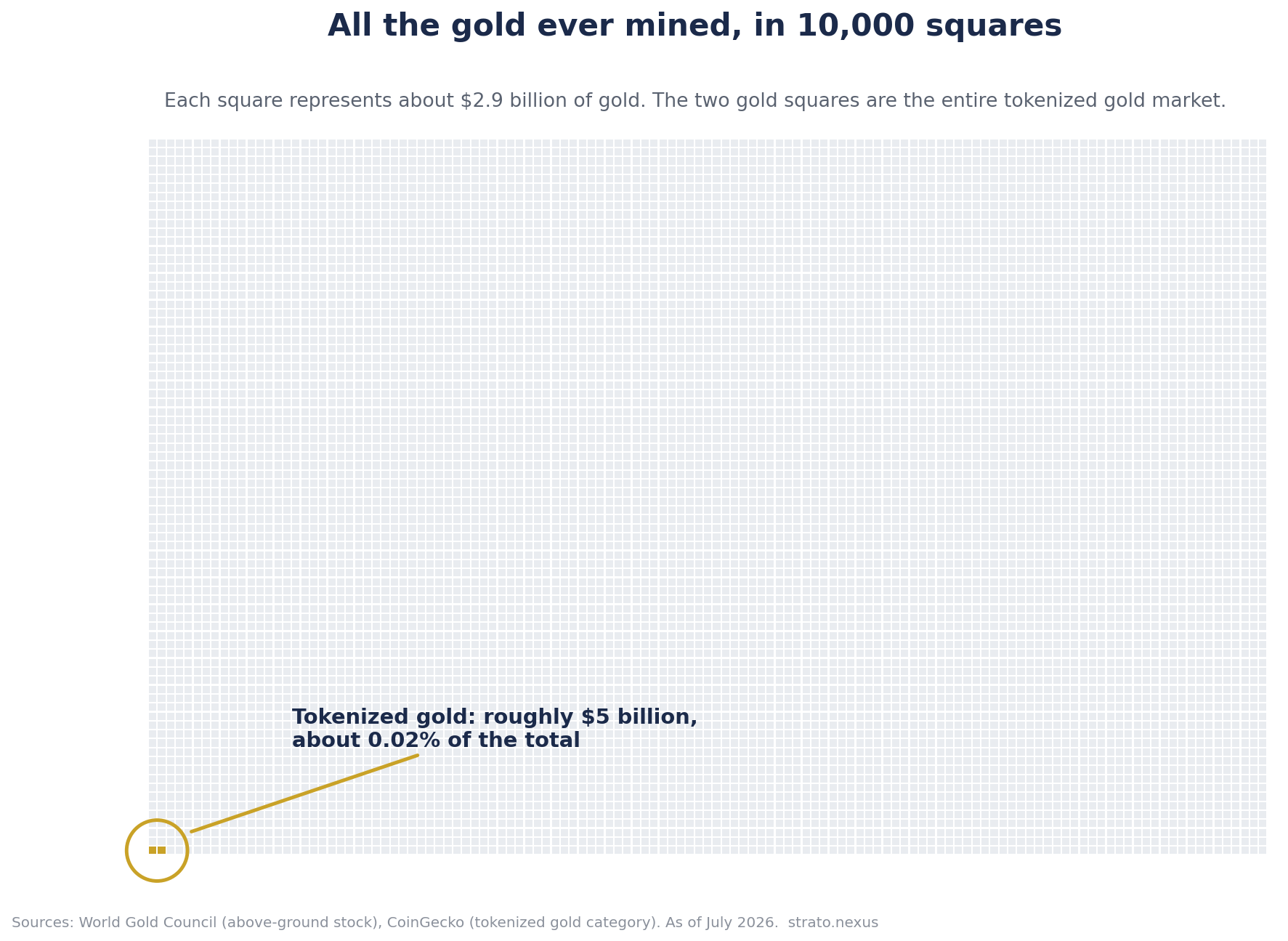
The smallness of that slice represents an opportunity as tokenization of stocks, metals, and other assets accelerates. We are still early. But tokenization is coming, and those who are prepared will benefit the most.
This guide explains what a gold token is, how the system works from vault to wallet, the types you will encounter, how tokenized gold compares to the other ways of owning gold, and what to check before you buy any of it.
The definition, expanded
A tokenized gold product has five parts, and understanding them tells you almost everything you need.
The token is a digital asset on a blockchain. You hold it in a wallet you control, and you can send it to anyone with an address.
The issuer is the company that creates tokens and stands behind the claim. Paxos issues PAX Gold. TG Commodities, part of Tether, issues Tether Gold. STRATO issues GOLDST.
The custodian stores the metal. Issuers rarely run their own vaults; they contract specialists.
The vault holds allocated bars, meaning specific, serial-numbered bars assigned against the tokens rather than a vague pool of metal somewhere.
The audit connects the two worlds. Independent parties count the bars on a schedule and publish attestations so holders can confirm the gold exists and matches the token supply.
How tokenized gold works, step by step
The lifecycle runs the same way across issuers.
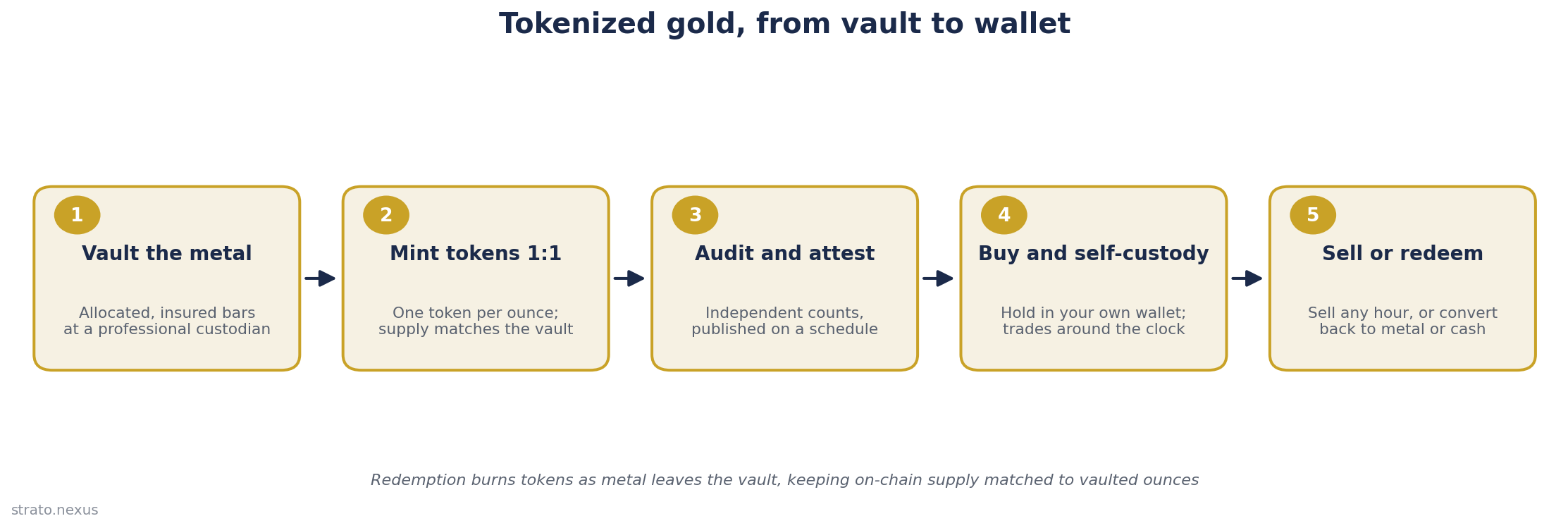
- The custodian vaults the metal. Gold meeting bullion standards goes into a professional vault, insured and allocated.
- The issuer mints tokens one-to-one. Tokens enter circulation as metal enters the vault, and in the reverse direction, tokens burn when metal leaves. Supply on-chain should always match ounces in the vault.
- Auditors attest on a schedule. Paxos publishes monthly attestations for its London gold. Tether publishes quarterly attestations for its Swiss vaults. STRATO's vaulting partner, BA Gold Enterprises in New York City, publishes monthly audit reports for the metal behind GOLDST.
- You buy and hold in a wallet. You can buy on an exchange, from the issuer, or on a decentralized market, then hold the token in self-custody like any other digital asset. The gold price drives the token price, so your position rises and falls with the metal.
- You sell or redeem to exit. Selling works around the clock. Redemption converts tokens back into metal or cash through the issuer, subject to minimums covered below.
Settlement is the quiet advantage in this loop. A US gold ETF trade settles the next business day. An on-chain transfer settles in seconds to minutes, any hour, any day.
The types of tokenized gold
Four categories cover the market, and they differ where it counts: backing, redemption, and yield.
| Type | Backing | Redeemable for metal | Pays yield | Examples |
|---|---|---|---|---|
| Fully backed, allocated | Specific vaulted bars, 1:1 | Yes, above a minimum | No, on its own | GOLDST, PAXG, XAUT |
| Pooled / unallocated | Claim on a general pool | Sometimes, on weaker terms | No | Various platform products |
| Native-yield | Vaulted metal plus a revenue share | Varies | Yes, built in | Kinesis (KAU) |
| Synthetic | Price exposure only, no metal | No | Varies | Derivative products |
Fully backed, allocated tokens are the standard. STRATO's GOLDST represents one troy ounce of 99.9% pure gold per token. PAXG and XAUT do the same.
Pooled or unallocated tokens claim a share of a general pile rather than specific bars. The structure is cheaper to run and weaker to hold, because your claim sits against the pool and the issuer rather than against numbered bars.
Native-yield tokens add a return to the metal. Kinesis Gold, denominated in grams rather than ounces, shares network transaction fees with holders, historically in the low single digits per year. The yield depends on that platform's transaction volume.
Synthetic gold exposure tracks the price with derivatives and holds no metal at all. If the backing question matters to you, and it should, read the fine print before assuming any gold-named token has gold behind it.
Tokenized gold versus the alternatives
You can own gold five ways. Each solves a different problem.
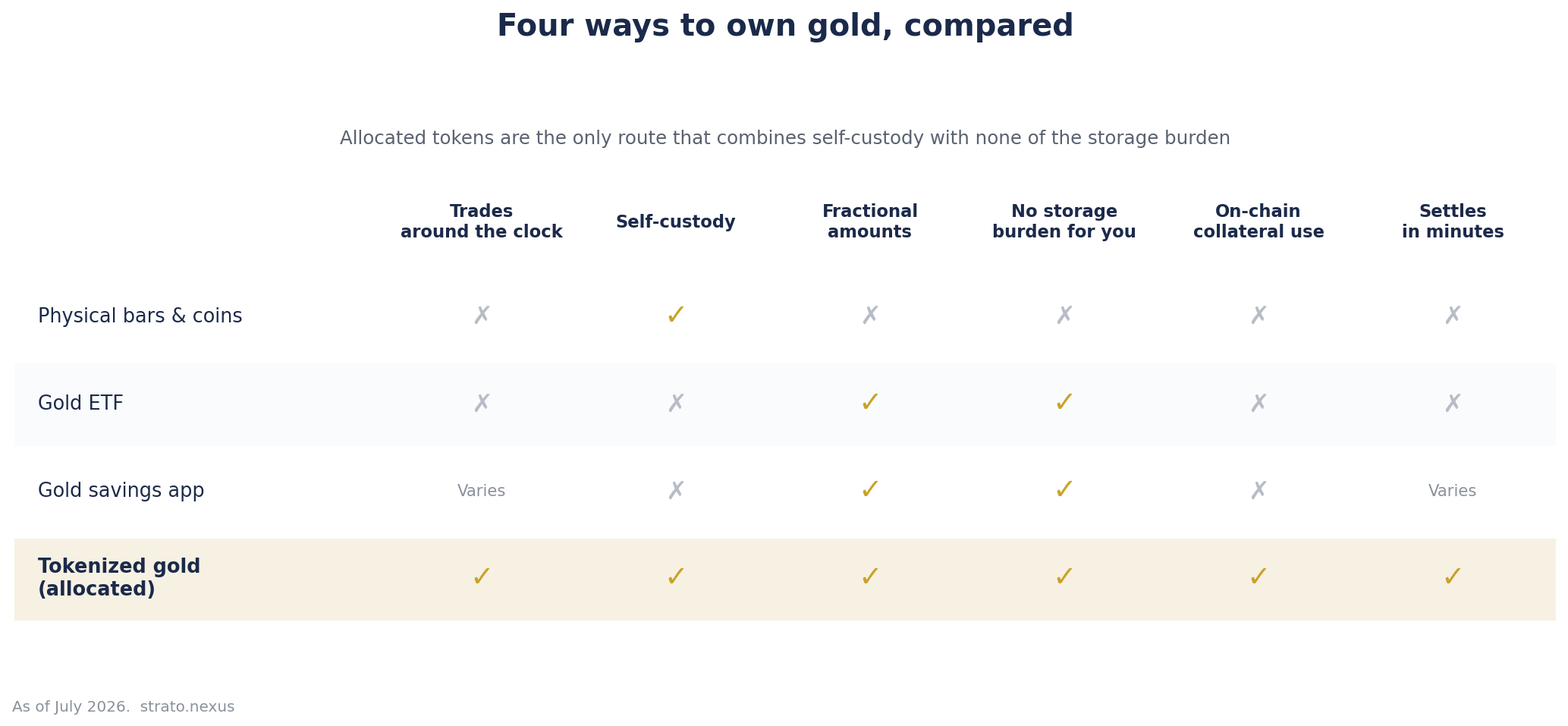
Versus physical gold. Bars and coins give you the metal in hand and every burden that comes with it: storage, insurance, dealer spreads on both ends, and the impossibility of selling a fraction of a coin. Tokenized gold delegates storage to a professional vault, trades in fractions, and moves anywhere in minutes. Physical wins if holding the metal yourself is the point. The token wins on everything logistical.
Versus a gold ETF. The ETF is the familiar route: a brokerage account, a ticker, a share tracking the gold price. It charges an expense ratio, about 0.40% a year for the largest fund, trades only during market hours, settles T+1, and cannot leave the brokerage system. A token trades around the clock, settles in minutes, and works as collateral in on-chain finance. The ETF wins on familiarity and fit with retirement accounts.
Versus "digital gold" savings apps. Apps in several countries let you buy grams of gold in an account the platform controls. Convenient, and the asset lives on the company's books rather than in your custody. A token in your own wallet removes the platform from between you and your gold.
Versus Bitcoin. People call Bitcoin "digital gold," and the nickname causes real confusion. Bitcoin is a scarce digital asset with no backing, valued for its fixed supply and its independence, and it can drop 40% in a month. Tokenized gold is a claim on physical metal, and it moves with the gold price. If you searched "digital gold" wanting the scarce digital asset, Bitcoin is your topic. If you wanted actual gold with digital convenience, tokenized gold is the product built for you, and this guide covers it.
What you can do with tokenized gold
Three things, each covered in depth elsewhere on this site.
Hold and move it, any hour. Gold markets close on nights and weekends. Tokens trade 24/7. During geopolitical shocks that break over a weekend, on-chain gold reprices while ETF holders wait for Monday.
Borrow against it. Lock gold tokens as collateral in a lending contract and draw stablecoins against them without selling, at rates from roughly 2% to 9% depending on the venue.
Earn yield on it. Lend it, pool it, or deposit it in a vault, and the same gold that tracks the metal's price earns a return on top, in the low to mid single digits for most methods.
Is tokenized gold real gold, and is it safe?
It's as real as the gold that backs it. But is it safe? That depends on the issuer.
A well-run gold token gives you a claim on allocated, audited, insured metal, and holders of the major tokens can verify their backing down to bar serial numbers. A badly run one gives you nothing. Here are how to tell them apart:
Proof of reserves. The issuer should publish evidence that vaulted ounces match circulating tokens, and the better ones let you check your own tokens against specific bars.
Audit frequency. Monthly beats quarterly, and either beats a one-time report from years ago. Independent auditors beat the issuer grading its own homework.
Redemption rights. A token you can convert back into metal or cash keeps the issuer honest. Read the threshold, the fees, and the process before you buy, since redemption terms reveal how seriously the issuer treats the backing.
Custodian identity. You should be able to name the company holding the metal and the city the vault sits in. An issuer that won't tell you is answering the question by refusing it.
Beyond backing, the risks of tokenized gold are the risks of the rails: smart-contract bugs, exchange failures, and the gold price itself, which falls as well as rises.
How to buy tokenized gold
On an exchange. Major exchanges list PAXG and XAUT against dollars and stablecoins. Buy, then withdraw to your own wallet if you want self-custody, since tokens left on an exchange sit in the exchange's custody. GOLDST from STRATO is coming to exchanges later this year.
On STRATO. GOLDST is available on the STRATO app, backed one-to-one by insured, monthly-audited gold vaulted with BA Gold Enterprises in New York, held in your own wallet on a chain built for vault-backed assets, with contract security monitored around the clock by an AI agent called Chonky. The same platform runs the venues where GOLDST can earn yield or back a loan, so the token and its uses live in one place. Buy GOLDST here.
On-chain. Decentralized exchanges trade gold tokens against stablecoins around the clock, wallet to wallet, no account required.
From the issuer. Paxos and Kinesis sell direct, with identity verification, and direct purchase can cost less at scale. STRATO is a permissionless network that sells its tokenized gold directly to you.
FAQ
Is tokenized gold backed by real gold?
The reputable products are. PAXG, XAUT, and GOLDST each hold allocated physical bars against every token, verified by published audits, and the better issuers let you trace your tokens to bar serial numbers. Products without published reserves and independent audits deserve your skepticism.
Can I redeem tokenized gold for physical gold?
Yes, above each issuer's minimum. STRATO has kept minimums lower than other tokenized gold issuers to make it easier for retail to redeem physical gold for their tokens.
Is tokenized gold a stablecoin?
No, and the confusion is common. A stablecoin pegs to a currency and aims to hold $1. Tokenized gold tracks the gold price, so it gains and loses value as gold moves. The "stable" part of tokenized gold refers to the one-to-one backing, never to a fixed dollar price.
How is tokenized gold different from a gold ETF?
An ETF share is a security you hold at a brokerage; it charges an annual fee, trades market hours, and settles the next business day. A gold token is an asset you can self-custody; it charges little or nothing to hold, trades continuously, settles in minutes, and works as collateral on-chain. The ETF fits retirement accounts and brokerage habits. The token does more.
Does tokenized gold pay interest?
Most of it pays nothing on its own; PAXG and XAUT are price trackers. Yield comes either from tokens built to share revenue, such as Kinesis, or from putting a standard gold token to work through lending, pools, or vaults.
Sources
- World Gold Council, above-ground gold stock: https://www.gold.org/goldhub/data
- Visual Capitalist, "Visualizing the World's Total Supply of Gold" (Nov 2025): https://www.visualcapitalist.com/worlds-total-supply-of-gold/
- CoinGecko, Tokenized Gold category: https://www.coingecko.com/en/categories/tokenized-gold
- CEX.io Research, "Tokenized Gold Q1 2026 Report": https://blog.cex.io/ecosystem/tokenized-gold-q1-2026-report-35490
- Paxos, PAX Gold (custody, attestations, redemption): https://www.paxos.com/pax-gold
Start earning on STRATO
Bridge crypto, borrow against gold and silver, and put your assets to work.
Launch App