
Announcing STRATO Rewards Season 2

Earn real yield on gold, silver & crypto — live on STRATO.
Launch AppEarn Points Toward TGE and Outsized Yields…While They Last
Season 2 of STRATO’s Rewards program is live, offering APYs over 500% across many different on-chain activities.
But those numbers will be lower with each week as more people join.
If you participated in Season 1, your points will carry over, and if you’re new, now is a great chance to get caught up. The position in points you build today, while pools are small, will directly impact token allocations around TGE.
We’ve put some of the best strategies below for you to get ahead. Dive in and:
- Learn what STRATO is
- Get the details on Season 2
- Find the best strategies to maximize yield and points
What is STRATO?
STRATO is the home of HardFi: powering hard assets with DeFi. It lets you borrow against gold and silver, as well as top crypto assets like ETH and BTC. All physical metals represented on STRATO are vaulted 1:1 in NYC, and redeemable in person. You can mint USDST against these assets via a CDP, with stability fees running approximately 2-3% annually, compared to 8-15% on other leading DeFi protocols.
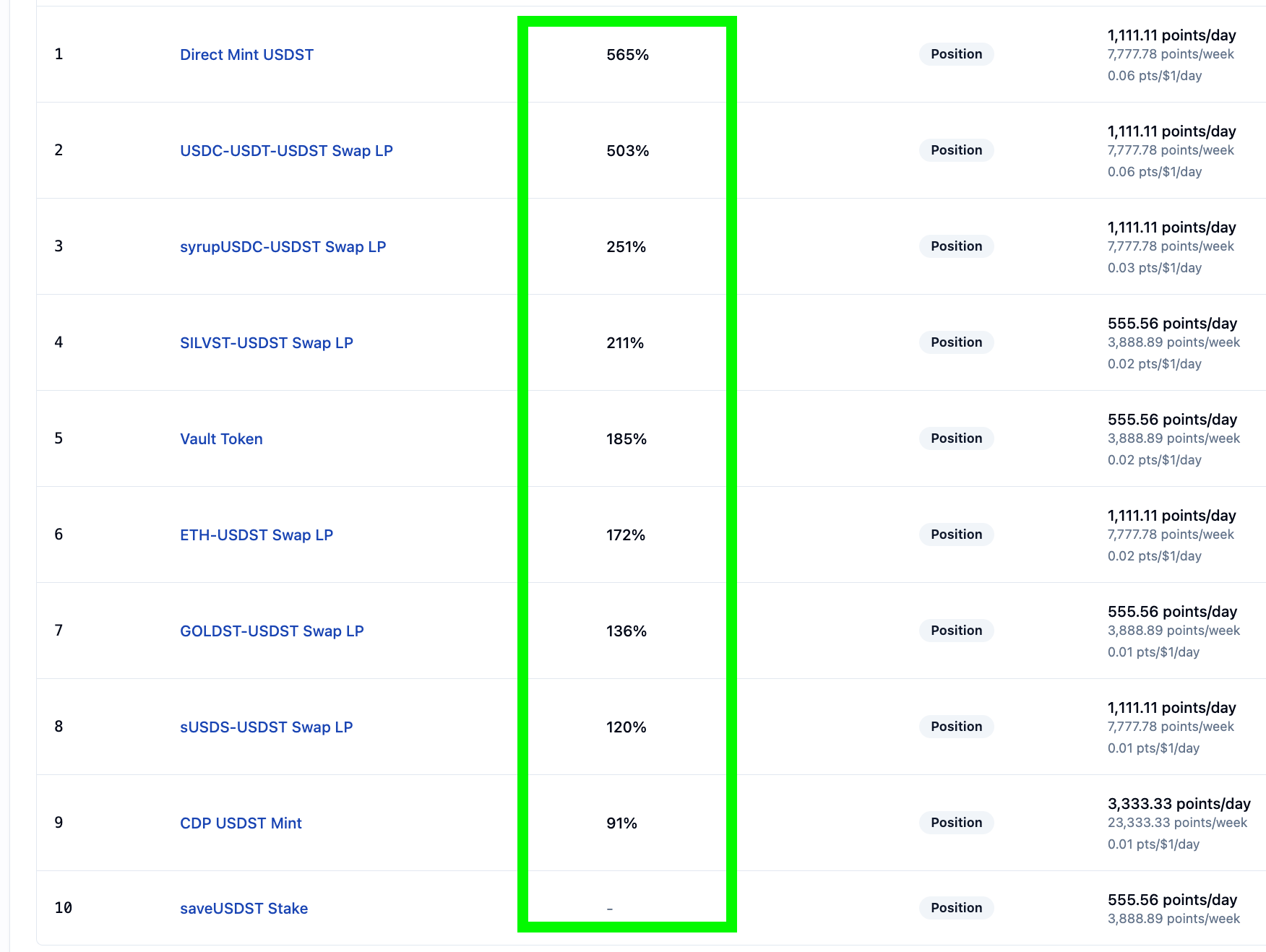
STRATO's CDP stability fee of approximately 2-3% gives traders a better spread for baseline yield, a baseline that is getting a huge boost during Season 2 of our rewards program. With current levels of points, you can add 91%-565% of incentive APY on top of that baseline, depending on your activity on-chain.
Those rates are high because Season 2 has just launched. They’ll decrease as more users join the program. It’s a case of “the early bird gets the worm.”
How Season 2 Works
Season 2 distributes 11,111.11 reward points per day across 10 on-chain activities. Your share of those points is proportional to your stake relative to everyone else in that activity. The smaller the pool, the bigger the cut per dollar. Fixed emissions divided by growing TVL is what produces the APYs on the dashboard, and it's also why those APYs will fall over time.
Points accrue in the reward contract to your address. You claim them from the Rewards dashboard whenever you want, and points will map to STRATO's native token at TGE. The more you accumulate before the token launches, the larger your allocation. Season 2 allocates approximately 1% of total token supply over its ~12-week run through Q2 2026.
The 10 Activities and What They Pay
Different activities have different levels of point emissions:
| Activity | Daily Points |
|---|---|
| CDP USDST Mint | 3,333.33 |
| Direct Mint USDST | 1,111.11 |
| USDC-USDT-USDST Swap LP | 1,111.11 |
| syrupUSDC-USDST Swap LP | 1,111.11 |
| ETH-USDST Swap LP | 1,111.11 |
| sUSDS-USDST Swap LP | 1,111.11 |
| SILVST-USDST Swap LP | 555.56 |
| Vault Token | 555.56 |
| GOLDST-USDST Swap LP | 555.56 |
| Savings Vault (saveUSDST) | 555.56 |
Current rankings:
Here's what the dashboard shows as of April 7th, 2026. These numbers change as capital enters and exits each pool. Smaller pools will have a higher per-dollar APY:
How to Get Started
Fastest path (two transactions after bridging):
- Bridge USDC or USDT into STRATO
- Direct Mint USDST — deposit stablecoins, receive USDST
- Deposit USDST into the Savings Vault
Two transactions after bridging puts you earning 221% APY in the Savings Vault through yield and point emissions.
Best for ETH, BTC, or on-chain gold and silver holders:
- Bridge your asset into STRATO
- Open a CDP: deposit your asset as collateral, mint USDST against it at ~2%-3% annual stability fee.
- Deploy that USDST into the Savings Vault or an LP pool
Your collateral stays locked in the vault and remains yours. You get it back when you repay the minted USDST plus the accrued stability fee. A CDP (Collateralized Debt Position) requires you to deposit more value than you borrow — if your collateral value falls too close to your debt, the protocol liquidates your position, so keep your collateralization ratio with plenty of buffer. Meanwhile, you earn points on the CDP position (91% APY currently) and on wherever you deploy the USDST.
Top STRATOgies with Video Walk-Through
STRATO's CDP stability fee runs approximately 2-3% annually. Most DeFi lending protocols charge 5-15%. That gap creates a carry trade, and Season 2 adds point emissions on top of it.
Borrowing at 2% against an asset already earning yield is where STRATO's structure separates from other DeFi protocols. Here is what that looks like in practice across three strategies, from simple to advanced.
The simple carry:
You hold wstETH earning ~3-5% in staking yield. You deposit it as collateral on STRATO. You borrow USDST at 2%. You swap that USDST for syrupUSDC, which earns ~4-5% yield passively. The cash-on-cash spread — what you earn on collateral plus what you earn on deployed USDST, minus the 2% borrow cost — runs roughly 5-8% before point emissions. On a $10,000 position at 80% LTV, that spread on the borrowed $8,000 alone returns ~$240-400 per year. Add the CDP incentive (91% incentive APY at current pool size) and the total picture is materially different.
The point: the carry trade earns without points. Points are the amplifier on top, and they're running at multiples of the baseline return right now because the pools are early.
The LST Leverage loop:
Post wstETH as collateral. Mint USDST via CDP at ~2-3% annual fee. Swap it for more wstETH. Post that wstETH as additional collateral. Borrow more USDST. Repeat.
Each pass increases your wstETH exposure, increases your carry spread, and increases your Season 2 points on the CDP. You stay long ETH throughout. This compounds your collateralization risk: if ETH drops, your liquidation exposure grows at each loop. Experienced DeFi users who understand leverage management can run this; others should stick to a single CDP.
The LP route:
Borrow USDST via CDP. Deposit it into the syrupUSDC-USDST LP pool (251% APY currently). You earn CDP mint incentives on the borrow position, organic yield from syrupUSDC while it sits in the pool, swap fees from the pool, and LP point emissions. Four yield sources from one flow of capital.
Start Now
Points accrue continuously while your capital is deployed and you claim them from the Rewards dashboard whenever you want.
At TGE, points convert to STRATO's native token. Season 2's ~1% allocation runs through Q2 2026. The earlier you participate, the more points you earn per dollar, because each dollar's share of daily emissions shrinks as TVL grows.
If you want the simplest entry, bridge stablecoins and deposit into the Savings Vault. If you want to maximize, open a CDP, mint USDST at ~2-3% annually, and run the carry trade into the pools with the highest remaining APY.
Start earning on STRATO
Bridge crypto, borrow against gold and silver, and put your assets to work.
Launch App